What if the most important part of your finished basement is the one component you'll never see once the project is complete? Many homeowners focus on the final paint color or the luxury vinyl plank flooring, but the hidden skeleton behind your walls determines whether those finishes stay flawless or start to crack. You likely understand that a finished basement offers a high return on investment, often exceeding 70 percent, yet the anxiety of moisture damage or navigating local building permits in Allentown and Bethlehem can feel like a major hurdle. It's natural to worry about the difference between load-bearing and partition walls when the structural integrity of your home is on the line.
By partnering with a specialized basement framing contractor, you can replace that uncertainty with the peace of mind that comes from expert craftsmanship. This article explains how professional framing secures your home’s foundation and prepares your space for a perfectly level finish. We will look at the 2026 safety standards for habitable spaces, including critical fire-blocking and egress requirements, to ensure your new living area is both beautiful and fully code-compliant. You'll learn how a precision-built frame prevents mold growth and provides the stable base needed for a lifetime of comfort.
Key Takeaways
- Understand why a precision-built skeleton is essential to prevent unsightly drywall cracks and uneven trim in your finished living area.
- Discover the critical role of moisture-resistant materials, including the requirement for pressure-treated bottom plates to protect against concrete contact.
- Compare the long-term benefits and costs of traditional wood versus modern steel studs for your 2026 basement renovation project.
- Learn how a professional basement framing contractor manages complex load-bearing walls and navigates local building codes for total structural peace of mind.
- Explore the methodical layout process that ensures every wall is perfectly square and level before the first nail is driven.
Why Quality Basement Framing is the Foundation of Your Remodel
Building a high-quality living space starts with the structural skeleton that supports your entire vision. This framework serves as the essential foundation for every subsequent trade, from the electrician running wires to the painter applying the final coat. By engaging a professional basement framing contractor, you ensure that the hidden architecture of your home is handled with technical precision. This critical phase is where your ideas for a quiet home office or a dedicated media room begin to take a tangible, physical shape.
Precision is the hallmark of quality work in any renovation project. When walls aren't perfectly square or level, the consequences ripple through every subsequent stage of construction. You'll often see the results of poor framing in drywall that cracks at the seams or baseboards that have unsightly gaps against the floor. A straight, plumb frame prevents these frustrations and creates a seamless canvas for the finishing trades. It turns a rough concrete box into a sophisticated environment where every corner is crisp and every door swings exactly as it should.
The Skeleton of Your Finished Basement
The vertical studs within your walls serve as more than just a place to hang drywall. They are the essential anchor points for everything from heavy kitchen cabinetry to wall-mounted televisions. Understanding the fundamentals of Framing (construction) is vital because it involves more than just nailing boards together. It requires a deep knowledge of load-bearing requirements and the specific needs of a below-grade environment to ensure long-term stability.
Safety is a central component of high-quality framing that often goes unnoticed by the untrained eye. Modern building codes require "fireblocking" within the frame to slow the spread of flames and smoke between different levels of the home. This involves installing specific materials at vertical and horizontal intervals to seal off the hollow spaces inside your walls. A knowledgeable basement framing contractor understands these nuances and ensures your project meets or exceeds current safety standards, providing you with steadfast peace of mind.
Framing Beyond the Walls: Soffits and Ceilings
Basements present unique challenges that aren't usually found on the upper floors of a home. You often have to work around low-hanging pipes, electrical conduits, and bulky HVAC ductwork that can't be moved. Professional framers don't just build a flat, low ceiling and lose valuable vertical space. Instead, they design custom soffits that hug the mechanicals closely. This methodical approach maintains the maximum ceiling height possible while keeping your home's vital systems tucked away but still accessible for future maintenance.
Having an expert on-site during the framing stage provides a final opportunity to identify hidden structural flaws before they are covered up. Before the walls are closed, we can spot foundation issues or moisture signs that might have been missed earlier. This proactive oversight offers a layer of professional reassurance, knowing your new living space is built on a foundation of integrity and expert craftsmanship.
Navigating Basement-Specific Challenges: Moisture, Codes, and Load-Bearing Walls
Basements present a set of environmental stressors that standard framing simply doesn't encounter. While upper floors stay dry and ventilated, lower levels are in constant contact with concrete, which is a naturally porous material. This means ground moisture can wick directly into your wall studs if they aren't protected. A skilled basement framing contractor understands that building in this environment requires a specialized approach to material selection and layout to ensure the longevity of your investment.
One of the most critical requirements involves the bottom plate, which is the horizontal board that sits directly on the floor. In every professional installation, this plate must be made of pressure-treated lumber to prevent rot and decay caused by moisture transfer. You can find more details on these essential safety standards in a Basement Finish Requirement Guide. Beyond the wood itself, we follow a methodical process to manage the environment behind your walls:
- Installing vapor barriers to block moisture migration through the foundation.
- Using pressure-treated lumber for any wood in contact with concrete floors.
- Maintaining a physical gap between the frame and the masonry wall to encourage airflow.
Moisture Management in the Lehigh Valley
Homeowners in Allentown and Bethlehem know that Pennsylvania summers bring significant humidity, which often settles in the basement. To combat this, we utilize a "thermal break" strategy by spacing our studs away from the foundation wall rather than attaching them directly. This creates a buffer that prevents temperature transfer and condensation. A 1-inch gap between the foundation wall and the wood frame is the industry standard for maintaining healthy airflow and preventing stagnant pockets of damp air from forming behind your drywall.
Identifying Load-Bearing Structures
Distinguishing between partition walls and load-bearing walls is a matter of home safety and structural integrity. Partition walls are simply used to divide your space into functional rooms, such as a bathroom or a gym, and they don't carry the weight of the house. Load-bearing structures, however, support the weight of the floors above and are vital to the stability of your entire home. You should never remove a steel post or a jack without consulting a structural engineer, as this could compromise your home's integrity.
When we encounter these necessary supports, we frame around them with precision to integrate them into your design. This might involve building decorative columns or reinforcing headers for wider doorways to maintain the strength of the opening. If you're ready to start planning your layout, our team at Apex Home pro can help you identify these structural elements early in the process. This professional oversight ensures that your remodel is as safe as it is beautiful, providing you with long-term peace of mind.
Wood vs. Steel Studs: Which Material is Right for Your Home?
Deciding on the right material for your basement walls is a pivotal step that influences both the cost and the longevity of your renovation. While wood has been the industry standard for decades, light-gauge steel has become a formidable contender for modern lower-level projects. A professional basement framing contractor will help you weigh these options based on your specific layout and long-term goals for the space. Each material brings distinct advantages to the table, and the best choice often depends on how you plan to use each room.
In 2026, wood stud framing typically costs between $25 and $45 per linear foot. Moisture-resistant steel stud framing is slightly more expensive, ranging from $30 to $55 per linear foot. This price difference reflects the specialized manufacturing and the inherent durability of metal components in a damp environment. For a deeper look at how these materials compare in various settings, you can explore this expert analysis of Metal Studs vs. Wood Studs. Beyond the initial investment, you should consider the environmental impact; wood is a renewable resource, whereas steel is often comprised of recycled content and is fully recyclable at the end of its life cycle.
The Case for Traditional Wood Framing
Wood remains a favorite for many homeowners because of its superior structural strength. If you plan to install heavy wall-mounted items like large televisions, custom cabinetry, or floating bookshelves, wood provides a solid anchor point that's easy to work with. Most local crews are deeply familiar with wood, which often leads to a faster installation pace. It's also the preferred choice for complex architectural details, such as tray ceilings or curved archways, where on-site adjustments are frequently necessary. Because wood is a solid material, it also makes the installation of standard door frames and trim a straightforward process for your basement framing contractor.
Advantages of Steel Studs in Basements
Steel studs offer a level of stability that wood simply cannot match in a below-grade environment. Because steel is inorganic, it will never rot, warp, or provide a food source for mold and mildew. This makes it an exceptionally reliable choice for non-load-bearing partition walls in areas prone to high humidity. You'll also benefit from the perfectly straight lines achieved with manufactured steel, which results in a flawless, "dead-level" surface for your drywall. While steel requires "wood blocking" to support heavy items, its resistance to the environmental stressors of a basement makes it a high-performance option for a modern, worry-free living space.
The Step-by-Step Process of Professional Basement Framing
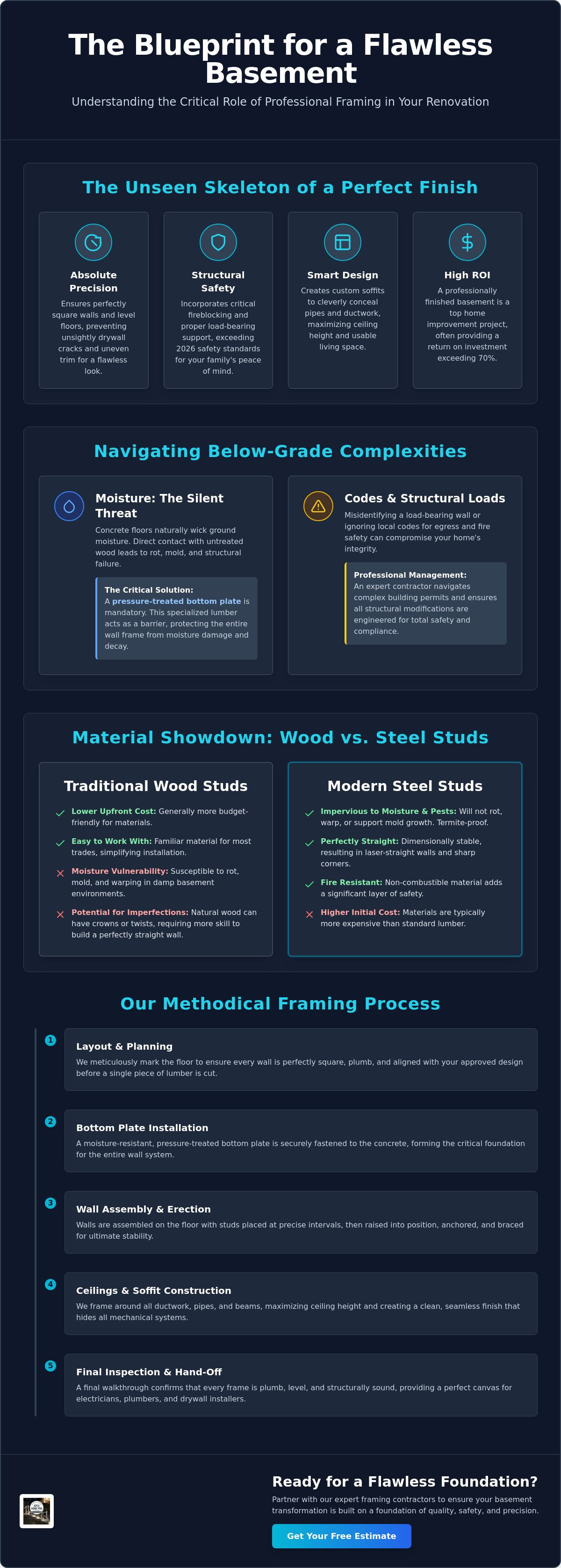
Every successful basement transformation begins with a precise architectural roadmap. Before a single board is cut, a professional basement framing contractor develops a detailed floor plan that accounts for room dimensions, doorway clearances, and the location of utility access points. This preparation ensures that your new living area flows naturally and maximizes every square inch of available space. It's much easier to adjust a line on a drawing than it is to move a wall once it's been anchored to your concrete floor.
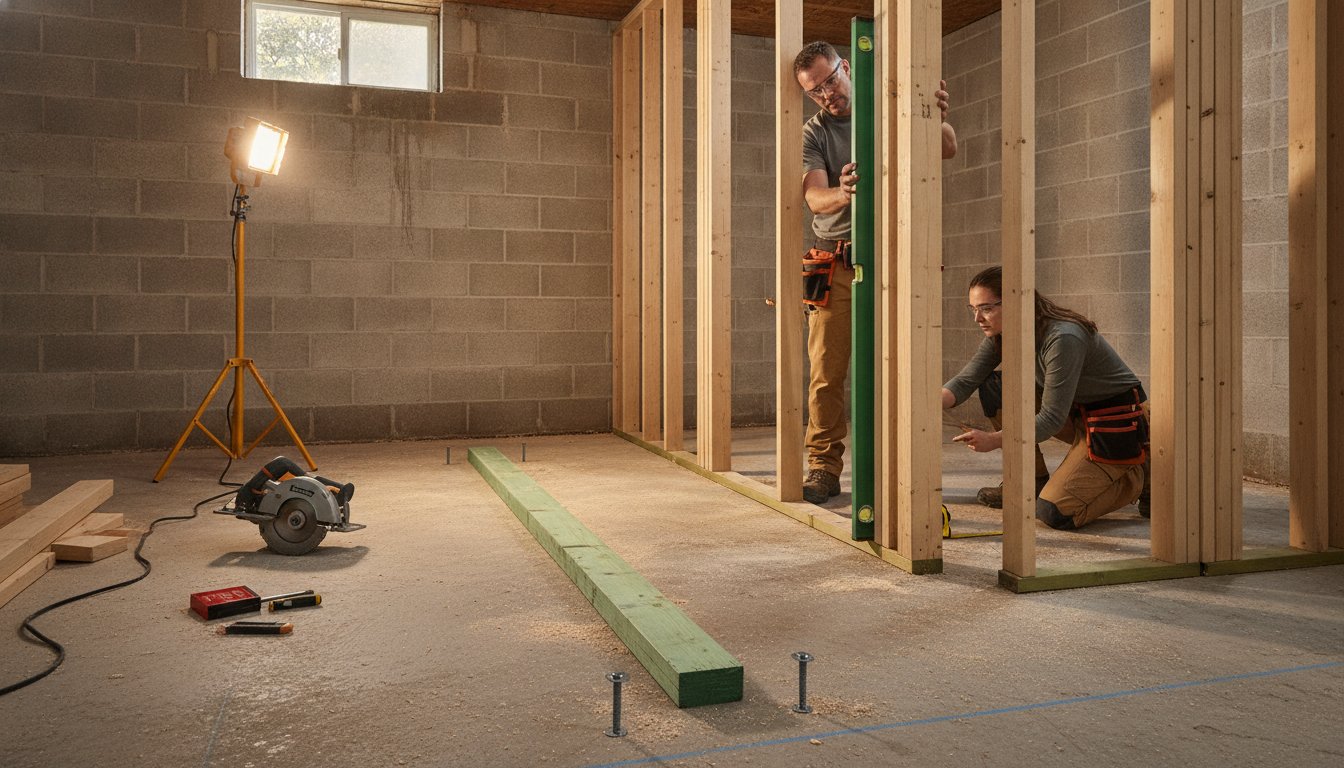
The physical work starts with the layout phase, where your chosen basement framing contractor snaps blue chalk lines across the concrete floor. This step translates your paper blueprint into a life-sized outline of your future home office, gym, or guest suite. We take extra care during this stage to ensure every corner is perfectly square. A mistake of even half an inch at the floor level can lead to significant alignment issues when you reach the ceiling, making this methodical layout the most critical part of the entire build.
In the unique environment of a basement, we often utilize "stick-framing" rather than building entire wall sections on the floor and raising them. While building on the floor is common in new home construction, basements often have low-hanging pipes or varying ceiling heights that make "stick-framing", placing each stud individually, a more precise option. This technique allows us to custom-fit every piece of lumber around the existing quirks of your home's foundation and mechanical systems.
Planning for Permits and Inspections
Local building departments in Allentown and Bethlehem have specific requirements that must be met to ensure your project is legal and safe. We handle the coordination of these permits to ensure your renovation adheres to the 2024 International Residential Code (IRC) standards. A framing inspection is required once the skeleton is complete but before any insulation or drywall is installed. A rough-in inspection is a mandatory check performed by local building officials to verify that all framing, fire-blocking, and structural components meet safety codes before they are hidden by insulation and drywall.
Framing for Egress and Natural Light
Safety is a priority when creating habitable spaces, especially if you plan to include a bedroom. According to 2026 safety standards, any sleeping room must have an egress window with a minimum clear opening of 5.7 square feet and a maximum sill height of 44 inches from the floor. We frame these openings with reinforced headers to support the weight of the house while accommodating larger window wells. This doesn't just meet code requirements; it also floods your lower level with natural light, making the space feel less like a basement and more like a natural extension of your home.
The final step is a comprehensive walk-through to install "blocking", extra pieces of wood placed between studs to provide solid support for future fixtures. We identify where you want to hang a heavy television, install kitchen cabinets, or mount bathroom towel bars. Taking the time for this final check ensures that your finishes are as sturdy as the frame itself. If you're ready to see your floor plan come to life, reach out to the team at Apex Home pro to schedule a consultation.
Partnering with Apex Home pro for a Seamless Basement Transformation
Choosing the right basement framing contractor is about more than just finding someone to nail studs together; it’s about securing the future of your home’s new living area. At Apex Home pro, we position ourselves as your Trusted Expert Guide, providing the professional reassurance needed to move from an empty concrete space to a fully realized room. Our team understands that the framing phase is the most critical window of opportunity to ensure the long-term stability and safety of your project. We take this responsibility seriously, delivering a level of precision that makes every subsequent step of your remodel easier and more successful.
Our approach is rooted in the belief that a general contractor should understand how every individual component fits into the final design. We don't view framing as a standalone task but as the essential first step in a comprehensive transformation. Because we also specialize in tile, paint, and flooring, we know exactly how a slightly unlevel wall can cause headaches during the finishing stages. By maintaining high standards from the very first day on site, we eliminate the structural flaws that lead to aesthetic issues later. This commitment to craftsmanship provides you with the stability and peace of mind that your investment is in capable, experienced hands.
The Apex Advantage: From Framing to Finish
The precision we bring to your basement frame creates a ripple effect of quality throughout the entire project. When your walls are perfectly plumb and your corners are exactly square, your tile lines stay straight and your flooring sits flat without unsightly gaps. This level of detail is what separates a standard basement finish from a luxury living space. Our deep local roots in Macungie, Whitehall, and Trexlertown allow us to provide personalized service with an understanding of regional building styles and environmental challenges. We invite you to view our portfolio to see how our methodical framing serves as the backbone for beautiful, code-compliant basement transformations.
Ready to Start Your Project?
Embarking on a basement remodel is a significant undertaking, and we're here to ensure the process is transparent and stress-free. We provide a clear roadmap for managing labor, materials, and timelines, so you always know exactly where your project stands. Our goal is to foster a collaborative relationship where communication is constant and your vision remains the priority. Whether you're planning a simple family room or a complex multi-generational suite, we have the expertise to build it right the first time. If you're ready to build a solid foundation for your new living space, follow the link below to get started.
Request a Free Quote for Your Basement Framing Project
Secure the Future of Your Home Transformation
Transforming your lower level into a vibrant, functional space is a significant investment that deserves a foundation of absolute precision. We have explored how high-quality framing acts as the essential skeleton for your home, ensuring that every subsequent layer of tile, paint, and flooring remains flawless for years to come. By prioritizing moisture management and strict adherence to local Allentown and Bethlehem building codes, you protect your structural integrity and your family's safety. Partnering with a specialized basement framing contractor ensures these technical details are handled with the expert craftsmanship your property requires.
Apex Home pro brings specialized trade labor and deep local expertise to every project, providing a full-service approach that removes the stress from complex renovations. Our team remains dedicated to professional reassurance and steadfast reliability throughout the entire project lifecycle. We invite you to take the next step toward a beautiful, worry-free living space by reaching out to our experts today to discuss your vision.
Get Your Professional Basement Framing Quote from Apex Home pro
Your vision for a perfect basement is within reach, and we look forward to helping you build it with confidence and long-term peace of mind.
Frequently Asked Questions
Do I need a permit just for framing a basement in Pennsylvania?
Yes, most municipalities across Pennsylvania require a building permit for structural work, which includes framing new walls in a basement. Local building departments in the Lehigh Valley, such as those in Allentown and Bethlehem, enforce these requirements to ensure every project meets the 2024 International Residential Code (IRC) for safety and structural integrity. Obtaining a permit is a vital step that ensures your renovation is inspected at critical stages and remains code-compliant for future home resale.
How long does it typically take to frame a standard-sized basement?
A standard basement of approximately 1,000 square feet typically takes three to five days to frame once the layout is finalized. This timeline can vary based on the complexity of your design, including the number of individual rooms, custom soffits for ductwork, and the installation of egress window headers. A professional basement framing contractor will provide a methodical schedule to ensure the skeleton of your new living space is built with precision and efficiency.
Can I use regular 2x4s for the bottom plate of my basement walls?
No, you cannot use standard kiln-dried 2x4s for any part of the frame that makes direct contact with a concrete floor. Building codes require pressure-treated lumber for all bottom plates because concrete is porous and naturally wicks moisture from the ground. Using pressure-treated wood prevents rot, decay, and mold growth at the base of your walls, providing a steadfast foundation for your drywall and finished trim.
Is it better to use wood or metal studs for a basement remodel?
The choice between wood and metal depends on your specific needs for structural strength versus moisture resistance. Wood studs are the traditional choice for their superior strength when hanging heavy items like cabinetry or large televisions. Metal studs are an excellent alternative for non-load-bearing partition walls because they are inorganic and won't warp or support mold growth. A skilled basement framing contractor can help you analyze the benefits of each material for your 2026 renovation goals.
How much space should be left between the framing and the foundation wall?
Industry standards recommend leaving a 1-inch gap between the new wood framing and the exterior masonry foundation wall. This space creates a necessary "thermal break" that prevents moisture from transferring directly from the concrete to your wood studs. It also promotes healthy airflow behind the finished walls, which is a critical component of professional moisture management in below-grade environments.
What is fireblocking, and is it required for basement framing?
Fireblocking is a mandatory safety feature that involves installing specific materials within wall cavities to slow the spread of flames and smoke. These blocks are required at vertical and horizontal intervals, typically every 10 feet, to seal off the concealed spaces inside your walls. This methodical approach is a non-negotiable part of modern safety codes and provides homeowners with essential peace of mind regarding their family's protection.
Should I frame the basement before or after the plumbing is roughed in?
You should always complete the framing phase before the plumbing and electrical "rough-in" work begins. Plumbers and electricians require the wall studs to be in place so they can properly anchor pipes, conduits, and junction boxes. Having the frame completed first ensures that all mechanical systems are correctly positioned within the walls and meet the necessary clearances for your final layout.
How do I know if a wall in my basement is load-bearing?
You can often identify a load-bearing wall by looking for structural elements like steel support posts, large beams, or walls that run perpendicular to the floor joists above. These components carry the weight of the entire house and are vital to its structural integrity. If you're unsure, you should never remove a wall or post without consulting a structural engineer or an experienced contractor. Modifying a load-bearing structure without professional oversight can lead to catastrophic damage to your home's foundation.